Sunday, 16 May 2010

Broken Rod Tip While Trout Fishing

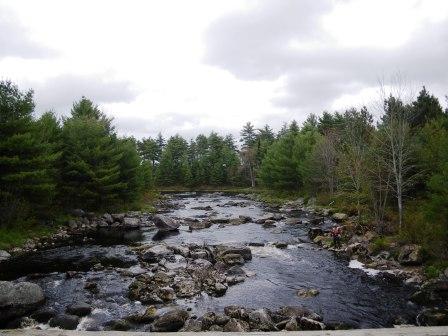
I was fishing last weekend in the backwoods of the Tobiatic and Medway country on land owned by the Bowater Mersey Paper Company. The weather was lousy but the howling wind did keep the black flies away. There were lots of trout around and they were fussy enough to make the fishing quite challenging.

I was using a five weight rod and somewhere between stopping for a sandwich and starting fishing again I managed to break the tip. Not quite sure how it happened but now I have to fix it.

The good news is that the repair won't effect the action of the rod.  I base that judgement on the fact that I fished the rest of the day with the broken rod and had only slight problems with the line wrapping around the stub of the blank between the last guide and the missing tip-top.

It still cast well and could handle a feisty Speckled Trout.


Usually you can fix a broken tip right in the woods. The glue that rod builders use to secure the tip-top is a heat set glue so you just need a Bic lighter to heat the tip, pull out the old piece of the blank and slide the tip onto the remaining unbroken section. That will get you through the day until you can do a more permanent job.

This one broke flush with the base of the tip-top so I couldn't get the piece out to slide it on in a new position. I've ordered a new tip-top from Cabela's which puts my favourite rod out of commission until the new part comes.


Shad fishing has continued to be great. This is the best year in a long time for me with loads of fish each time out. Because my good rod is busted I've borrowed a rod from my daughter.

It's a 5 weight I built for her this spring.

The other day I found myself landing a whack of fish using a fly I designed and tied and a rod I built. Have to admit to feeling a bit of self satisfaction. There really is a lot more to fishing than the fish.

Labels: , , , , ,

Sunday, 17 May 2009

Shad Flies

Here is a peek at what I am carrying in my Shad fly box this year.


-
-
My first shad of the year I caught on this green one. I got it from Larry at Fishin’ Fever the other day. I like to go in and see what the latest patterns are and then, once I know what is working, I’ll tie a handful of variations. The truth is; if you are not hanging a few on the bottom, you are not fishing in the right zone. So, it is a costly business if you don’t tie your own.


Here is my go to fly for when nothing else seems to be working. It is a Crazy Charlie; I think that is what it’s called. Most Bonefish patterns will work amazingly well for Shad. It is probably the hook facing up design that allows one to fish it with better technique as much as any other design element.


These are the flies that were most successful over the last few years. Like most anadromous fish, each generation of returns seems to have a definite colour preference when it comes to taking flies. Variations of green and white seem to be most successful but one year red was by far the most preferred with orange a close second.


My first cast of the season I will always go with a white body, green head or a totally green. If that doesn’t seem to be working I’ll keep changing, working through from red to orange and then pink, pure white and so on.

The main secret to catching fish seems to be going fishing. Everything else is subject to change.

Labels: , , , , ,

Friday, 9 May 2008

Fly Fishing for Shad –Reading the Water

As in any fly-fishing, reading the water is critical to deciding how to approach the task of presenting your fly. In Shad fishing with a fly rod it is no less important. The well-known spots are usually crowded. Shad fishing is after all a very exciting and often social event. We fly fishermen need a little more elbowroom though so tend to disperse along the stream.


When the Shad are running in the spots I fish, they swarm up the stream in little schools of ten or twenty fish. These groups dart upstream a ways then swirl around and head back down stream seemingly randomly until suddenly they are gone. Within minutes another group or maybe the same one, passes and does the same upstream move degenerating into swirling chaos before reforming into a somewhat orderly school and heading away upstream again. What we are seeing is a group of males pursuing a larger female.

On a good day, there is almost always at least one group of fish in sight, usually several.


Knowing the fish are there is half the battle but it is what they are doing when you cannot necessarily see them that is important. These fish are here to spawn. While in fresh water they are not feeding so must conserve as much energy as they can to be ready when the moment comes to be the winner in the contest to reproduce.


They way I translate this into a fishing strategy is this:

Unless actually chasing a female or in the case of the female, unless actually being chased by the males. Shad are going to seek the path of least resistance in their upstream journey. They will rest when and where possible. If you hang a fly in front of them for long enough they will bite it, just to get the darned thing out of their face if for no other reason. I know that last bit sounds kind of dumb but hey, at least I have a plan.

To my thinking, there are a few points of interception a fly angler should concentrate on. The first is the deep slow water close to the mouth of the river the Shad are running up.
Every Shad in the river has to pass this area.

To fish this just cast almost straight across, let the fly sink and strip back with a rhythmic, longish pull. Do not be afraid to pause and let the fly sink between strips. Also every now and then fish directly downstream a few inches out from the bank.

Farther up stream, I look for a few types of water. My favourite is a stretch of shallow riffles immediately above a deeper, broadening of the stream. The little pods of fish come racing upstream, hit the shallows, mill around a few moments then fall back to the deeper section, seemingly to rest and recharge before committing to another dash upstream.

Here, I position myself upstream and work the fly down and across the lip of the deep section, extending about six-inches on each cast to cover it thoroughly. Work the fly a little with a bobbing or lifting motion.

The next type of water I look for, especially on a bright day, is a long stretch of deep water with lots of conflicting currents. I figure this is a trade off for the fish. The dark depths give them security so they are inclined stay there but they will not continuously fight the current so will rest wherever it is blocked or slower.

Also, think of the way a Seagull will glide along in the draft of a ferryboat without flapping its wings. He has found a sweet spot of upwelling air and only needs minor adjustments to stay there for hours. I think fish do the same thing in a current. They look for the sweet spots where the lift of the water hitting a bank or boulder will let them rest with little energy expended.

I fish it so the fly does the same thing the water does. It tumbles along the bottom then rises up in front of them – in theory anyway.

One more spot I will always fish on a bright day is anywhere there is a noticeable shadow such as a bridge will cast or even a tree or brush along the banks.

Many times, I have watched fish mill around in the shadow of a bridge, unwilling to venture back out into the bright sunlight but not particularly comfortable in the water they are holding in either.


I first discovered this fishing with my brother Warren on the Nictaux. (I think it was the Nictaux River. He will doubtless remember.) The water was too fast and shallow to be promising but I saw the telltale swirls and tips of fins so cast downstream to the edge of the bridge’s shadow. The strike was instantaneous. As long as I was content to cast along the slowly moving shadow’s edge there was a fish there willing to take.

I will not go through every turn and vagary of a river but offer these as examples of the sorts of places to look for and things to think about when on the river fly fishing for Shad.

Remember; the very best time to fish them is just at dusk but the very best time to go fishing is whenever you can. That means the fishing is not always going to be easy.

The truth is that I learn something new about Shad fishing every time I am out. Some of it completely contradicts what I would have sworn was true before leaving home so take this stuff with a grain of salt and let me know if you figure out something that will help me catch a few too.

Labels: , ,

Fishing May 7th

I made it out last night after work for a bit of Shad fishing.

I was having no luck at all until a fellow named Phil ambled down the stream and stopped to chat. He mentioned that he had tried several different coloured flies and when he changed to green started hitting a few fish.

Needless to say, I immediately changed to a green fly. You can see the results in the pictures.

All told, pretty slow until sometime between almost dark and should have left fifteen minutes ago. A few fish landed, two fish hooked and lost plus a lot of bumps and strikes with no hook-ups.

It was interesting watching Phil fish on down the river. He worked the fly more than I am inclined to but out fished me so I will pay a lot more thought and attention to that. He also fished a stretch of water I had walked right by with some success. Lesson learned.

Labels: ,

Friday, 15 February 2008

American Shad, Traditional Recipes for The Poor Man’s Salmon


Here is a picture of me with a big fish I caught a few seasons ago. It is an American Shad. You can see from the picture why a Dobson Clip can come in handy.

In the last few years, I have started to look forward to the Shad run with the same excitement as opening day for Trout. These fish are truly awesome on light fly gear. In fact, the Shad run is a great tune-up for the Salmon season.

Most fly anglers I have encountered on Shad water practice catch and release for Shad, me included. There was a time though when the Shad and Shad roe were an important food source. Here are a couple of the traditional recipes, one for Baked Shad and the other for broiled Shad roe.

------------------------------------------------
Traditional Baked Shad:

· One whole shad (at least three pounds but the bigger the better) scaled and cleaned.
· One cup of chopped onions.
· Two strips of bacon

Place the fish in pan large enough for the length of the fish. Stuff the fish with chopped onions. Make a few cuts in each side of the fish. Then, lay the strips of bacon on the fish. Add salt and pepper freely. Bake at 350 degrees until tender and cooked through -about a half hour, give or take.
-----------------------------------------------
Broiling Shad Roe

· Wipe and dry the roe well on a paper towel or cloth
· Add salt and pepper freely
· Place on greased cookie sheet
· Broil for five minutes, turn and broil the other side for five more minutes.
· Serve with melted butter

Labels: , , , , ,

Sunday, 13 May 2007

The poor man's salmon

Fly-fishing for Shad has become a spring ritual for me. If you have never tried it I encourage you to give it a go.

I've heard them called "the poor man's salmon" and its true. When you are playing a big Shad they fight amazingly like a grilse. They don't jump as often but are great to tangle with.

A guy I chatted with at streamside said the other night "they are a great tune-up for Salmon season". I like to fish them because they are very forgiving about taking but demand all your skill to land.

 It is not uncommon to hook three or four to every one landed, especially in the first of the run. As you get more skilled and your gear tuned up, you'll see that ratio quickly reverse.

If you can comfortably handle one of these silver demons you can confidently fish with a fly for anything that swims here in the East.

Wait a second; I've never caught a big Striped Bass on a fly rod so I'll reserve my earlier comment. I have caught some small stripers, they are called 'schoolies' I think, about twelve or fourteen inches and very plentiful in mid-May in some of our rivers.

Labels: , ,