Sunday, 16 May 2010

Broken Rod Tip While Trout Fishing
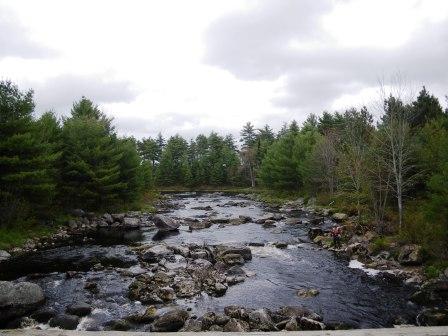
I was fishing last weekend in the backwoods of the Tobiatic and Medway country on land owned by the Bowater Mersey Paper Company. The weather was lousy but the howling wind did keep the black flies away. There were lots of trout around and they were fussy enough to make the fishing quite challenging.

I was using a five weight rod and somewhere between stopping for a sandwich and starting fishing again I managed to break the tip. Not quite sure how it happened but now I have to fix it.

The good news is that the repair won't effect the action of the rod.  I base that judgement on the fact that I fished the rest of the day with the broken rod and had only slight problems with the line wrapping around the stub of the blank between the last guide and the missing tip-top.

It still cast well and could handle a feisty Speckled Trout.


Usually you can fix a broken tip right in the woods. The glue that rod builders use to secure the tip-top is a heat set glue so you just need a Bic lighter to heat the tip, pull out the old piece of the blank and slide the tip onto the remaining unbroken section. That will get you through the day until you can do a more permanent job.

This one broke flush with the base of the tip-top so I couldn't get the piece out to slide it on in a new position. I've ordered a new tip-top from Cabela's which puts my favourite rod out of commission until the new part comes.


Shad fishing has continued to be great. This is the best year in a long time for me with loads of fish each time out. Because my good rod is busted I've borrowed a rod from my daughter.

It's a 5 weight I built for her this spring.

The other day I found myself landing a whack of fish using a fly I designed and tied and a rod I built. Have to admit to feeling a bit of self satisfaction. There really is a lot more to fishing than the fish.

Labels: , , , , ,

Thursday, 3 April 2008

Signs and Signals for the Fly-fisherman


One of the pleasures of the journey to becoming a fly angler is gradually growing awareness and curiosity about the natural world that accompanies it.

It makes sense that this happens. In the search for trout, you are often actually searching for what the trout might be feeding on. Connections between seemingly unconnected things start to become obvious - just not always easily understood.

Here is an example.

One of my favorite places to dry fly fish is in Kejimkujik Park. It is a stretch of the Mersey River called the Eel Weir after a Mi’kmaw artifact – a line of stones placed to form a “v” shaped fence with an opening at the centre. Alders were cut and placed along this fence to force the eels or other fish to swim through the opening and into a trap.
It is a lovely stretch of water dumping out of George Lake, flowing deep and cold.

The time to go is when the Indian Pears also known as Serviceberry first start to bloom. Local fly-fishermen wait for that signal. It tells them that the trout have started to drop down from the deep waters of the lake and into the river.

A signal I wait for is the sound of the first Spring Peeper. It tells me that the smelt have started to run. When the smelt are running is the time when a fly angler has a fair chance to connect with a land-locked salmon at the mouths of brooks along the Shubenacadie system.

Sometimes you know or can figure out why these signs and signals work, other times not so much. I like it better when I do not know why. It just seems more mystical that way.

Labels: , , ,